When your competitive intelligence is answering the wrong question.
Every two weeks, our Managing Director Michiel Mol steps away from the day-to-day to double down on Made’s Executive Exchange. In this series, Michiel shares a fresh perspective on what’s currently shaping some of the most essential industries. In scope today: why most competitive intelligence is dangerously outdated, and what to do instead.

The Executive Exchange #04.
Antwerp, Belgium - April 8th, 2026
I’m going to start this edition a little differently. Early February, I became a father for the first time. And as any new parent will tell you, something shifts in the way you look at the world the moment you hold your very own first child.
Time slows down, and simultaneously speeds up. Your priorities rearrange themselves overnight. However, in between those early feeding moments, sleep-deprived and wide awake at the same time, my mind kept circling back to a conversation I had just before going on paternity leave.
Let's dive into this new story in the fourth edition of The Executive Exchange!

We are living in what analysts call a “Crisis of Relevance.” Consumer priorities are fluctuating at a pace that most organizations simply cannot match.
The one with a market map and dozens of logos.
I believe it was mid January when I was sitting across the board of a European FMCG player, discussing growth strategies. At some point during the meeting, their Chief Strategy Officer pulled up a slide: the one with a market map with dozens of logos, neatly arranged by segment and size, with a verdict stamped at the bottom:
“Market saturated. Limited room for entry.”
I’d seen this exact slide a hundred times before. And every time, it leads to the same conclusion:
“Too crowded. Don’t bother.”
So I challenged them and told them the story of Loop Earplugs, a Belgian company that entered one of the most commoditized, low-margin markets imaginable and turned it into a growth engine worth over €126 million in annual revenue. The room went quiet. Then the questions started flowing. By the end of the meeting, the board had fundamentally shifted their perspective on what “competitive intelligence” should actually mean.
That conversation stuck with me and somewhere between the 2 AM feeds and the 5 AM diaper changes, I knew I would write about it in this fourth edition of The Executive Exchange. Because what I’m about to describe is a genuine strategic blind spot that is costing companies real growth, real revenue, and real relevance. And with the rise of AI-powered tools that can now track shifting customer needs in real time (what we at Made call an AI Growth Engine), there is simply no excuse left for relying on static market maps to make strategic bets.
Why competitive intelligence matters more than ever.
Let me start with the basics. Competitive intelligence, or CI, is the practice of understanding the forces that shape your market so you can make smarter strategic decisions. For decades, this has meant tracking competitors, monitoring market share, analyzing pricing structures, and mapping out who’s selling what to whom.
And for decades, that approach worked reasonably well. Markets moved slowly enough that a quarterly CI report could still be relevant by the time it reached the boardroom.
Those days are gone.
We are living in what analysts call a “Crisis of Relevance.” Consumer priorities are fluctuating at a pace that most organizations simply cannot match. According to Accenture’s Life Centricity research, 95% of global executives say their customers are changing faster than their businesses can keep up. Let that number sink in. Ninety-five percent. In such an environment, a CI report that is six months old might as well be six years old.



The real problem: we’re counting players instead of tracking needs.
Here’s what I’ve come to believe after years of working with companies across consumer products, manufacturing, and other essential industries: the fundamental flaw in most CI isn’t a lack of data. It’s asking the wrong question.
Most large companies approach competition as a headcount problem. They look at a sector, count the number of players, measure market share, calculate the TAM (Total Addressable Market), and draw their conclusions.
Too many players? “Red ocean, don’t enter.” Big addressable market? “Green light, let’s go.”
This logic is safe and defensible in a boardroom, but it creates two consistent failures.
The first is what I’d call a false negative: you walk away from markets that look crowded on paper but still contain massive unmet needs. The second is a false positive: you enthusiastically enter “big markets” where the real customer jobs are already being handled well, and the only way to compete is to discount your way in. That’s how so many corporate market entries end up feeling like expensive déjà vu.
The fundamental flaw in most customer intelligence isn’t a lack of data. It’s asking the wrong question.
The mistake lies in confusing market saturation with needs saturation. These are fundamentally different things.
A market can have fifty players and still be wildly underserved, because all fifty are solving yesterday’s problem while the customer has already moved on to tomorrow’s.
This is where the JTBD (Jobs to be Done) framework becomes essential. Instead of asking “how many companies are selling X?”, the right question is: “are the specific jobs that customers need to get done right now actually being fulfilled properly?” People don’t buy products. They “hire” solutions to make progress in a specific circumstance, whether functional, social, or emotional.
Once you adopt that lens, the competitive landscape looks entirely different. Your real competitor isn’t necessarily the other brand in your category. It’s whatever gets “hired” today: a workaround, a cheap substitute, doing nothing, tolerance, avoidance, habit. And the real opportunity isn’t an empty market. It’s an underserved job in a crowded one.


Decommoditizing the commodity: the Loop Earplugs case.
This is exactly the story I shared with that FMCG board, and it’s the story that changed the direction of the conversation we were having at that time. It’s a story about Loop Earplugs, a Belgian company that I think every C-suite executive should study.
Founded in 2016 by two childhood friends and engineers, Loop entered a market that, by every traditional CI metric, was a “do not enter” zone. The earplug market was commoditized, low-margin, and dominated by cheap foam cylinders. A classic logo slide would have told you: “Saturated. Low barriers to entry. Price war imminent.”
But Loop didn’t look at the logo slide. They looked at the shifting Jobs to be Done. And they saw something the incumbents had completely missed: the “job” of an earplug had fundamentally changed. In a world shaped by Instagram culture, open-plan offices, rising awareness of neurodivergence, and a growing focus on wellness, the job was no longer simply “block sound.” It had become something far more nuanced.
The job was: “I want to protect my hearing at a concert but still look cool doing it.” The job was: “I need to focus in an open-plan office without looking antisocial.” The job was: “I’m overstimulated and I need to control the noise in my environment without broadcasting my vulnerability.”
The story of Loop Earplugs proves that a market is only “too crowded” if you’re trying to do exactly what everyone else is doing.
By addressing these specific, evolving human needs, Loop didn’t just enter a market. They created what strategy theorists call a “Blue Ocean” right in the middle of a red one. They proved that a market is only “crowded” if you’re trying to do exactly what everyone else is doing.
The results speak for themselves. Loop achieved a staggering 15,275% revenue growth between 2018 and 2022, winning the Deloitte Technology Fast 50 twice. By 2023, they had reached €126.5 million in annual revenue, selling over eight million pairs worldwide. The New York Times named them the best earplugs for concerts. Fast Company ranked them among the World’s 50 Most Innovative Companies in 2024, placing them number one in the Design category.
All of this in a market that traditional CI would have dismissed as “too crowded.” The lesson is clear: a saturated market and a saturated set of needs are two very different things. Loop didn’t find an empty market. They found an empty job inside a full one.
The AI Growth Engine: making jobs-based intelligence operational.
The Loop case illustrates something broader. Jobs-based CI has always been “the right idea.” Academics and strategists have been advocating for it for years. The problem was always practical: it was too slow, too manual, too qualitative, and too expensive to fit the cadence of executive decision-making. Conducting focus groups, analyzing interviews, synthesizing qualitative data. By the time the insights landed on a desk, consumer preferences had already shifted again.
That excuse is gone.
LLMs (Large Language Models) and AI don’t replace human judgment. But they do make jobs-based CI fast enough to run continuously. And that changes everything. At Made, we call this an AI Growth Engine: a system that continuously tracks the velocity of human needs and translates those signals into strategic action.
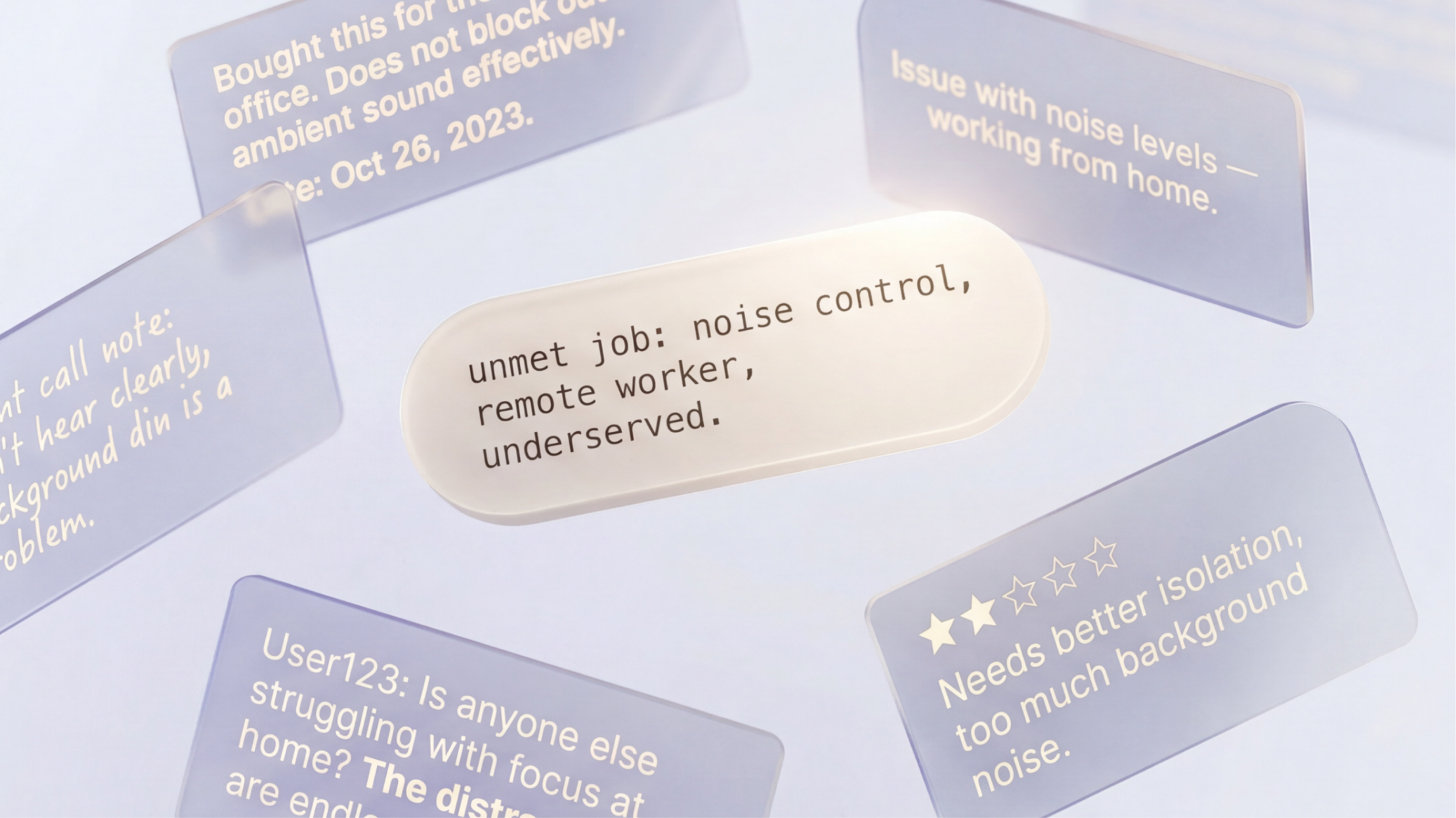
Imagine feeding your existing data into such an engine: customer service transcripts, product reviews, return reasons, sales call notes, forum discussions, and competitor messaging. Instead of a quarterly report that tells you “there are 50 companies selling coffee makers and the market is saturated,” your AI Growth Engine tells you: “Yes, there are 50 companies selling coffee makers. But as of last month, 40% of online reviewers are specifically complaining about noise levels because they’re now working from home, and none of the top ten brands have addressed it.”
Same market. Same fifty players. But a completely different strategic picture. That’s a new Job to be Done. That’s an entry point. And an AI Growth Engine is the only tool fast enough to spot it before the window closes.
The main reason most companies keep defaulting to “count the competitors” is a psychological one. I understand the instinct. But understanding it doesn’t make it right.
The path forward.
I’ll be honest with you. The main reason most companies keep defaulting to “count the competitors” is a psychological one. Logos on a slide feel objective. TAM feels defensible. Jobs and emotions feel “soft,” even when they’re the real drivers of market behavior. I understand the instinct. But understanding it doesn’t make it right.
For C-level leaders in consumer products and manufacturing, I believe this translates into two fundamental shifts.
First, reframe your CI question. Stop asking “how many players are in this market?” and start asking “where are people still struggling to make progress, and what are they hiring instead?” That single question will reveal more strategic opportunity than any market map with logos ever could.
Second, build an AI Growth Engine for continuous listening. The data is already there, in your reviews, your support tickets, your sales call transcripts, and in millions of public conversations happening online every day. An AI Growth Engine can turn that qualitative noise into a legible signal, at a speed and scale that was simply impossible two years ago. The companies that build this capability first will have a compounding advantage that latecomers will struggle to close.
So, the next time you look at a potential market and see a crowded field, don’t turn away. Look closer. Ask yourself: is this market actually full, or is it just full of companies solving yesterday’s problems?
And at Made, we’re ready to help you find that answer.



.jpg)