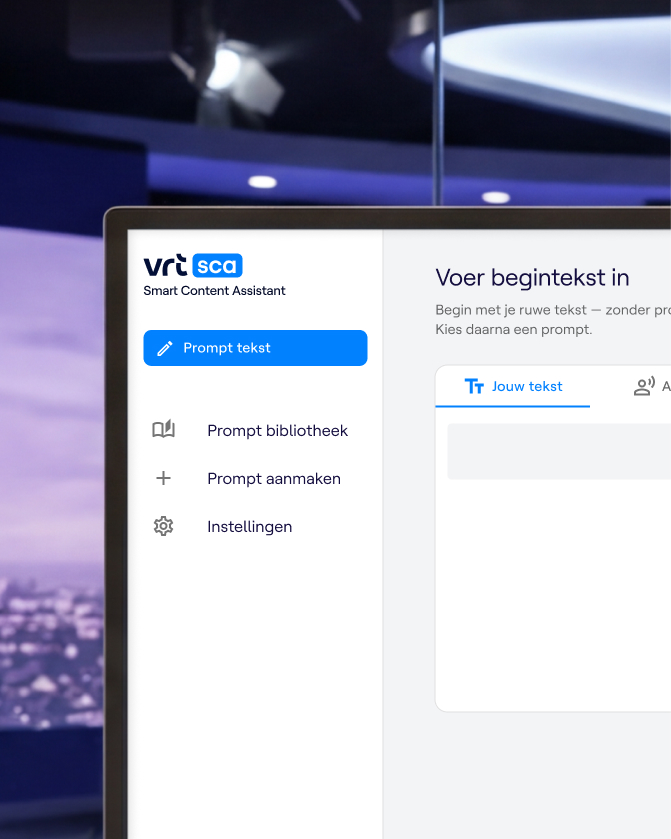
The user experience of VRT's Smart Content Assistant.
Antwerp, Belgium - March 25th, 2026
VRT, the Flemish broadcaster and one of Belgium’s leading newsrooms, runs an internal AI tool called the Smart Content Assistant. It helps editorial teams repurpose stories across platforms in the right tone, format and length.
Since its launch in March ‘24, the tool has generated over 113,000 interactions and is used by more than 200 people across the organisation. When rapid adoption outgrew the original interface, VRT partnered with Made to redesign the user experience from the ground up.
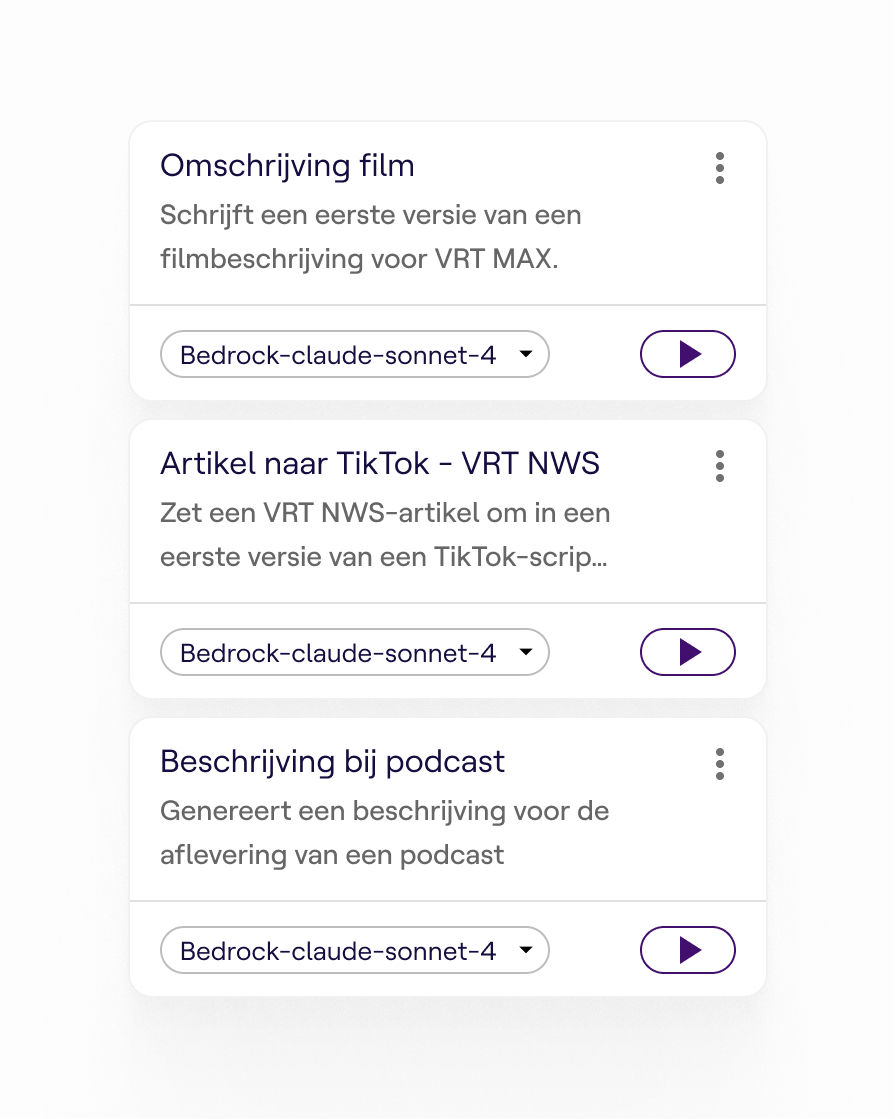
The tool operates as a shared prompt library where VRT staff can select pre-built prompts, upload text, audio or documents, and receive content suggestions tailored to a specific brand and channel.
Making liquid content.
In the current day and age, every modern media organization faces the same pressure: a single story needs to work on a dozen platforms.
A long-form article about a complex political event that’s being published on the website, for instance, might need to appear a few minutes later as a WhatsApp message, a push notification, a video description and as a summary in the evening newsletter.
Each channel and every news brand demands a distinct tone, length and format. Kicking off every piece of content from a blank page consumes hours that could be spent on actual reporting.
That challenge is exactly what the Smart Content Assistant was designed to solve. The tool operates as a shared prompt library where VRT staff can select pre-built prompts, upload text, audio or documents, and receive content suggestions tailored to a specific brand and channel. Staff can also create their own prompts or adapt existing ones, turning the platform into a vehicle for organizational knowledge sharing as much as a productivity tool.
The Smart Content Assistant helps us to bring stories to audiences in a way that matches people’s preferences in media consumption nowadays: fast, mobile, visual and tailored to an audience’s expectations.
“The Smart Content Assistant helps us define and test use cases for which AI is or isn’t relevant,” says Catho Van Den Bosch, Product Designer at VRT’s Data & AI team. “It helps to bring stories to audiences in a way that matches people’s preferences in media consumption nowadays: fast, mobile, visual and tailored to an audience’s expectations. And always with editorial responsibility staying with the newsroom.”
The impact is easiest to understand through concrete examples. The production team behind De Ochtend ("The Morning"), for instance, which is VRT’s current affairs talk radio programme, used to spend roughly two hours writing descriptions after every three-hour live broadcast to repackage the show for the streaming platform.
Now they upload the broadcast transcripts to the Smart Content Assistant, which generates first drafts of descriptions and titles. That time goes back into preparing tomorrow’s programme rather than processing today’s. A human editor always reviews the output before publication, though.

When adoption outpaces design.
The Smart Content Assistant started as a proof of concept roughly two years ago. But as more teams discovered its value and usage scaled rapidly, a clear need emerged to turn it into a fully fledged product.
“Driven by our Data & AI team, we started building the tool as a proof of concept, but along the way a real need was identified within VRT to develop this into a full product,” Van Den Bosch explains. “Today it’s a supporting production tool with more than 200 users, and it’s still growing. It also helps shape the direction of responsible AI implementation across VRT.”
That growth brought new challenges. Prompt discovery, for instance, needed to be easier. Usability across departments with different workflows needed rethinking. And adding a standalone tool to an already crowded set of editorial systems inevitably created friction. VRT recognised it was time to bring in external expertise to step back and evaluate the full picture.
A proof of concept can get away with rough edges. A daily production tool used by hundreds of people across departments cannot.
Where Made comes in.
“A proof of concept can get away with rough edges. A daily production tool used by hundreds of people across departments cannot,” says Craig Soenen, Team Lead Digital at Made. “Therefore, the interface of the Smart Content Assistant really needed to be intuitive, efficient and aligned with how editorial professionals actually work. That’s the lens we brought to this project.”
With the adoption rate going through the roof fast, Made’s digital team re-examined the full interface of the Smart Content Assistant and identified where the user experience could be optimized to match the platform’s growing user base while expanding functionality.
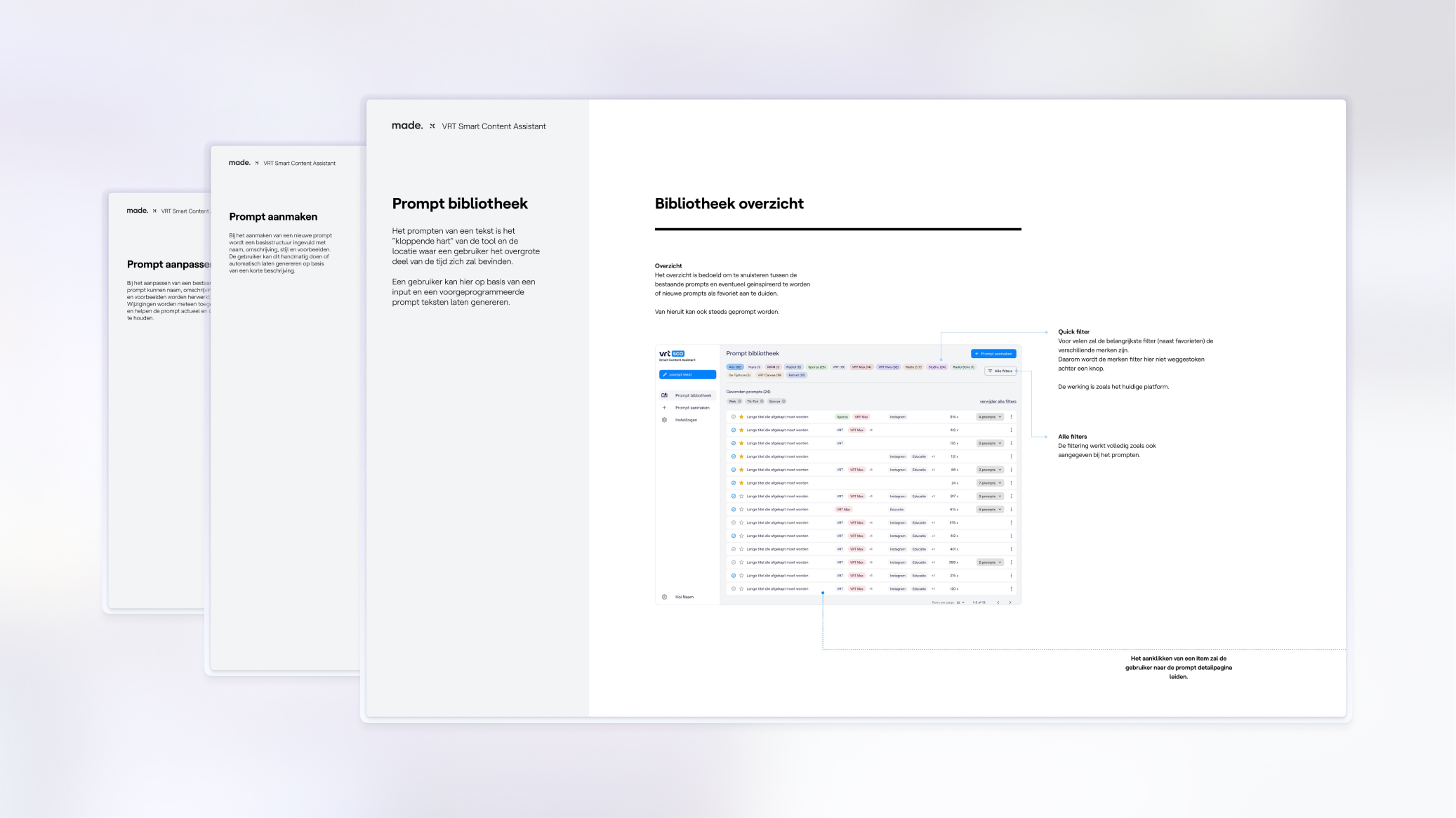
“To kick off the project, we took a step back to evaluate where improvements on user experience actually could be made,” Craig explains. “We defined the user needs, the most essential functionalities and shaped clear user stories mapping out a full UX review for every single one of them. Based on the outcomes, we designed solutions, prototyped them and used them for validation and testing. Afterwards, we went through careful iterations with VRT’s development teams and Catho’s Data & AI department to further finetune the functionality. After we completed the UX layer, we added a visual design layer to the project.”
The Smart Content Assistant is not a finished product. By design, it never will be. As VRT's editorial teams discover new use cases and AI capabilities continue to evolve, the tool will keep adapting.
For Made, the VRT project is a case in point for what happens when AI development and experience design work in tandem. The technology only delivers on its promise when the people who depend on it every day can actually use it without friction.
That's not an afterthought. That's the whole point.