Executive Summary
Antwerp, Belgium - December 22nd, 2025
By Tim Van den Bergh,
Director of Consumer Products
At the Europe Nutraceutical and Functional Food Summit (ENFF) in Brussels, we witnessed a debate that could define the next decade of food innovation: will the next generation of food be based on natural ingredients or functional ones? Picking sides, however, won’t necessarily solve the debate. What consumer brands need to focus on is the outcome of food.
After three days of discussions with industry leaders, researchers, and food innovators, we came home with a clear belief: the brands that will win in this space are those that can articulate what specific health outcome they're solving for, whether processed or not. Those that strive for precision explanation and transparent communications will hold the better cards.


The context food brands cannot ignore.
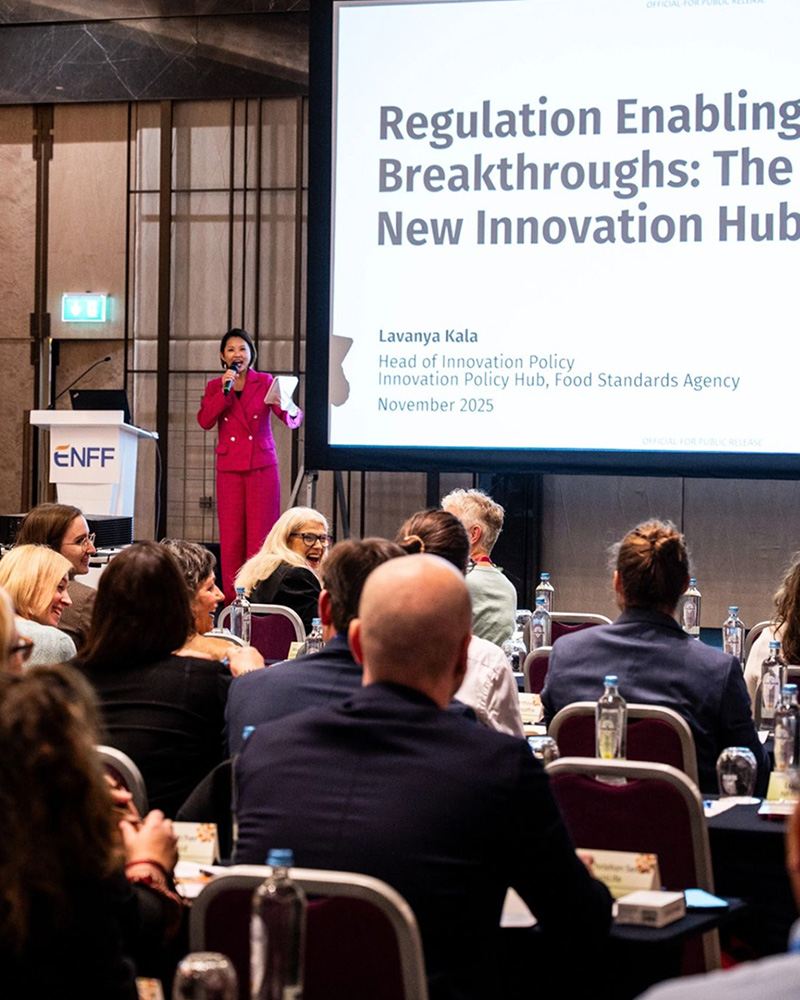
Walking through the halls of the Europe Nutraceutical and Functional Food Summit (ENFF) in Brussels, you couldn’t escape the fact that food is high on the global agenda. For obvious reasons, as consumers are becoming increasingly food conscious. However, the numbers tell a confronting story: despite caloric abundance, we are in fact starving for nutrients as more than 50% of all adults lack essential micronutrients.
Hence, the backdrop to every presentation I witnessed at ENFF was sobering.
According to a 2025 review in Frontiers in Nutrition, micronutrient inadequacy affects a surprisingly large portion of Europeans, even in high-income countries. Vitamin D deficiency alone affects up to 40% of the population. The Zero Hidden Hunger EU project found that approximately 70% of European citizens fall into at-risk groups for nutritional deficiencies. And while these numbers target Europe, the same goes for regions in North America.
Contrary to what one might expect, this isn't a problem of scarcity. It's a problem of modern lifestyles and food systems that have been optimized for convenience, margin, shelf life, and taste… but not for nourishment.
The situation creates a massive opening for brands as there's genuine demand for products that actually solve the micronutrient inadequacy authentically. Brands that make the right choices now, can lead the industry for years to come.
© Video from Tetra Pak

Nature vs. science: the road to the next generation of food.
Let’s zoom in on what, for me, was the red threat of ENFF 2025: what does the next generation of food look like? In that respect, ENFF 2025 revealed a clear split in perspectives on achieving optimal nutrition in the years to come.
On the one hand, there’s a group of naturalists arguing that the only way forward is backward. By returning to whole, minimally processed soil-to-table nutrition. Their scepticism of ultra-processed foods is well-founded and partly justified by the past as "processing" often meant stripping fiber and nutrients to add sugar, salt, and stabilizers. To make cheap ingredients taste better. To extend shelf life. To enable mass production.
On the other hand, there are technologists who claim technology is precisely the way to go. Food innovators that showcase how precision fermentation and molecular fortification can actually solve the world's nutritional deficits. Not by processing less, but by processing smarter. This group advocates the development of foods enriched with ‘functional ingredients’. Think protein-enriched yogurts, soups, spreads, snacks, or dairy alternatives. Think added choline for early brain development, L-theanine for stress reduction, and omega-3s for cardiovascular health, all backed by rigorous clinical evidence.
The food industry is investing heavily in the latter group. Food tech is a booming business, with the European functional food market projected to hit $168.5 billion (approx. €158 billion) with a CAGR of 8% according to the Grand View Research 2023-2030 report. Unsurprisingly, though, as functional foods offer both societal value and economic potential. Research shows consumers are indeed willing to pay a premium price for these foods enriched through new food-tech methods, but only if products genuinely contribute to their health rather than slipping into marketing claims that sound better than they are.
In either case, both naturalists and technologists are chasing the same outcome: better health through better nutrition. My takeaway for brands? Choosing sides in the nature vs. science debate is a distraction. Brands should be explaining food outcomes and this is exactly where I see them struggle.
My takeaway for brands? Choosing sides is a distraction. Brands should be explaining outcomes and this is exactly where I see them struggle.
Focus on the outcome of your food.
What we at Made believe is that, to win the food market in 2026 and beyond, brands must stop asking "How (much) should we process?" and start asking "Why are we (not) processing in the first place?"
Based on what I’ve heard at ENFF 2025, here's how brands can use this strategic shift in their advantage.
Define your nutritional point of view. Every food brand needs an answer to a simple question: What specific health outcome does your product deliver? Vague claims like "supports wellness" or "made with natural ingredients" no longer differentiate.
Consumers are increasingly literate about nutrition, and they're looking for precision. They don't just want to know what isn't in the food (no GMOs, no additives); they want to know what the food does to their body and mind. This doesn't mean every product needs to be fortified, though. If you are a tech-forward food brand, just don't hide the science. If you are a natural food brand, validate the nutrient density.
Consumers are increasingly literate about nutrition, and they're looking for precision. They don't just want to know what isn't in the food, they want to know what the food does to their body and mind.
Earn the right to process. Consumers have every right to be suspicious of food processing. The industry has a bad track record of engineering food for addiction (the "bliss point") through sugars, additives, …
Brands entering the functional food space must work harder to demonstrate that their processing adds genuine value. This means transparent labeling, clinically validated dosages, and a willingness to show the science. Trust is the currency, and it's easily lost. If you add Omega-3s, show the bioavailability data. If you process, explain that you are processing for absorption, not for shelf-life extension.
Segment your strategy by market maturity. Cultural attitudes toward food technology vary dramatically. North America and Asia show more openness to functional and smartly processed foods; Europe remains anchored in tradition and locality. But the landscape is shifting.
The implication for brands is that you cannot rely on a one-size-fits-all innovation pipeline. This requires market-specific positioning strategies, not just translated packaging. A protein bar in the US might lead with "Science-backed," while the same bar in France must lead with "Source ingredients," with science as a secondary validator.

An accelerating force: the GLP-1 consumer.
The shift toward outcome-based nutrition isn't just a strategic preference, though. It's a shift that’s being accelerated by forces emerging from outside the food industry itself.
GLP-1 medications like Ozempic and Wegovy have already been used by over 40 million Americans, with projections suggesting that households with GLP-1 users will account for more than a third of all food and beverage sales by 2030. What makes this relevant for the natural-versus-functional debate is that these consumers have essentially opted out of it. They don't care whether their food is minimally processed or precision-engineered. They care whether it delivers maximum nutritional value in minimum volume.
According to research presented at UC Davis's Innovation Institute for Food and Health, individuals taking GLP-1s consume 55% more fruits and vegetables, 65% fewer sugary drinks, and 62% less alcohol. They're actively seeking protein-rich, nutrient-dense options with measurable health benefits. In other words: they embody exactly the outcome-focused mindset this article argues brands should serve.
This emerging consumer segment validates the core thesis here. Whether you're a naturalist brand championing whole foods or a technologist brand fortifying with functional ingredients, the GLP-1 consumer will judge you on the same criterion: what does this product actually do for my body? The brands positioned to answer that question clearly, with transparency and precision, will capture this growing market. Those still leading with ideology over outcomes will find themselves irrelevant to an increasingly significant share of consumers.
The shift toward outcome-based nutrition isn't just a strategic preference, though. It's a shift that’s being accelerated by forces emerging from outside the food industry itself.
Outcome-centric thinking to counter the consumer's scepticism.
The brands that impressed me most at ENFF 2025 weren't the ones with the flashiest tech or the prettiest farms. They were the ones thinking in systems. It means understanding that the competition isn't just the product on the shelf next to them; the competition is the consumer's skepticism. It means moving from product-centric to outcome-centric thinking.
As we move forward, the most successful brands will be those that can articulate a coherent nutritional philosophy and be totally transparent about it. They will stop fighting the "Nature vs. Tech" war and start focusing on the consumer's health outcome.
At Made, we specialize in defining that philosophy. We help brands look past the trend reports to understand the human behavior driving them, building business models that are resilient, profitable, and, above all, purposeful.
The technology is ready. The consumer is needy. The only missing piece is the strategy to connect them.