.jpg)
What changes and what doesn't when AI enters the studio.
Antwerp, Belgium - February 12th, 2026
By Robin Verheyden, Senior Digital Designer
Made is an end-to-end innovation studio.
It means we provide innovative solutions in every phase of the innovation funnel. From strategy and business design to industrial product design, digital platform design and platform development.
Like everyone working in these fields right now, especially in the designer space, we are also taking a stand on what artificial intelligence truly means. For us. For our customers. And for the way we collaborate and communicate.
In this article, I’m putting on my Digital Designer goggles and I'm zooming in on how we currently use AI, how we've used it in the past and how I think we will be using it in the future. I'll share how we use it in the designer process and I'll share to what extent I feel AI is changing the craft of a digital designer in the current day and age.
Let's dive in!

Getting your head around AI.
As I am writing this, we can already look back on a significant periode of time in which we discovered, tested, applied and adjusted AI Tools, AI Agents and AI Workflows. It still is astonishing how times flies when you're having fun, right?
In the current day and age, people still get overwhelmed with new AI tools every week. That's going on for quite some time now. Another model update. Another AI startup entering the scene. Another co-pilot added to existing software.
Looking at this series of events from a designer perspective, I can only come to the conclusion that, in fact, tools have always changed. A new tool is nothing 'new' really.
Clipart libraries became Shutterstock assets. Photoshop's slice tool gave way to Sketch's leaner interface. Figma's Auto Layout shifted us toward thinking in code-like constraints. Each change felt significant, but the craft always remained.
This time, however, change feels a bit different.
Not just because of what it is that's actually changing, but because of how fast it's changing. Generative AI usage jumped from 33% to 71% in a single year. That’s hyperspeed.
But instead of chasing every new release, we at Made have been focussing on understanding: what's the actual shift in our work?
The gap between designers who understand why something works and people who just know how to prompt is going to get wider, not narrower.

The craft moved, but it's here to stay.
The digital craft we are all so proud of used to be visible in sheer execution. Hours in iterations. Days in drafts. Deep consideration in the spacing. Choosing the right typography. Today, however, anyone with a Figma Make or Midjourney subscription can generate a polished design.
I must admit: initially, this felt uncomfortable.
Today, it no longer does. Because, for work that's meant to last, AI alone won't cut it. At least, not yet. If you've seen one AI generated interface, you've seen a hundred.
AI slop is everywhere these days, going from concept definition all the way to visual output. Everywhere there are people putting a lot of effort in producing the same average-of-averages output from AI tools.
Sure, it raised yesterday's "average" to today's "decent" and made it trivially easy.
That's exactly why I feel the designer craft matters more today than it did yesterday. Because of reasons of quality assurance and the increasing risk of going to market with AI slop, time and time again.
There's an analogy we use at the company floor, as "both the floor and the ceiling are rising".
- Yes, the floor shot up... A "decent" design is free and instant. It's up to designers to demonstrate why the work matters. More than ever, our craft is now located in curation, direction, and taste. It's in the ability to know what'll stand out and what's generic.
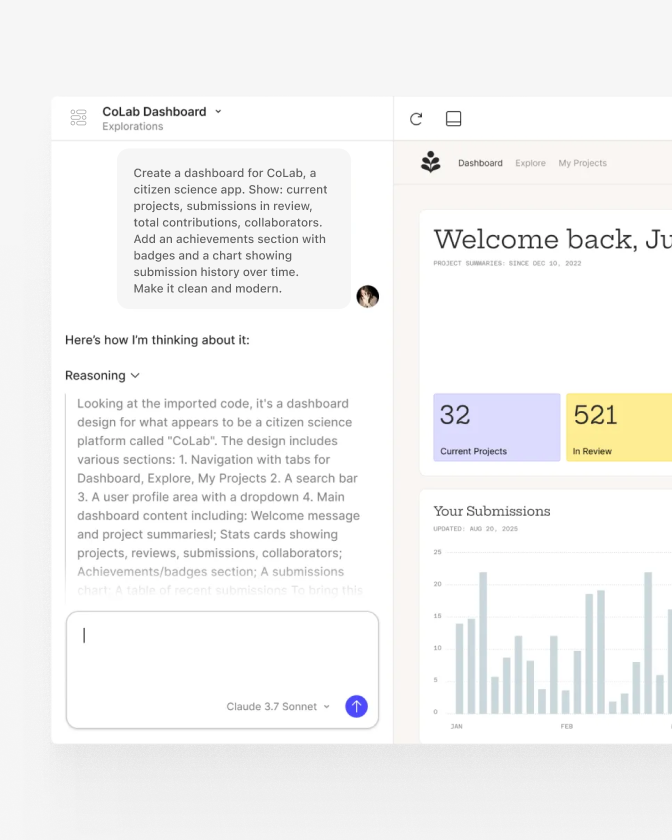
- ... but so has the ceiling. Experienced designers can now work at a level that was previously impossible. Designers who used AI during ideation produced 56% more ideas and 13% more variety (IDEO, 2024). More exploration, faster iteration, going much further with ideas.
We're developing new skills because of AI. Take, for instance, learning how to communicate intent to models clearly. Or understanding their biases. That's prompt engineering; knowing exactly how an AI model reacts, which AI tool is right for which job, and how to chain them together.
What's new? What holds?
As a designer with many years of experience in the field, I believe I can say indeed: we're developing new skills because of AI. Who isn't?
Take, for instance, learning how to communicate intent to models clearly. Or understanding their biases. That's prompt engineering; knowing exactly how an AI model reacts, which AI tool is right for which job, and how to chain them together. It entails setting the boundaries before you start: determining what can vary, what stays fixed, what range you're working in. And when you get back 100 variations of a particular design, we need to know what to look for and how to judge it fast.
It's like directing a very ambitious, but somewhat unpredictable junior designer at the speed of light.
However, for me, the fundamentals of digital design haven't changed. We still need to understand the actual problem before jumping to solutions. We still need empathy for people and all the messy, irrational behavior. that goes with them. We still need to see how different elements fit together as a system, and where it might break, or what will scale and what won't.
A designer's taste still matters.
An experienced designer still knows what's generic and what actually solves the problem. Sometimes it's as simple as choosing the right typography; a detail that shapes the feel of everything. Storytelling that articulates why a design decision matters. You can't really prompt your way to these things. You develop them by making things, breaking things, understanding why something works beyond "the AI made it."
As the Nielsen Norman Group noted: "while generative tools can speed up tasks, they still can't replicate the insight of human designers.” The best designers have always been translators. Between what the business needs and what users need. Between strategy and execution. Between vision and reality.
That part, for me, hasn't changed.
.jpg)
How we're using AI today in the design process.
From prompting to orchestrating.
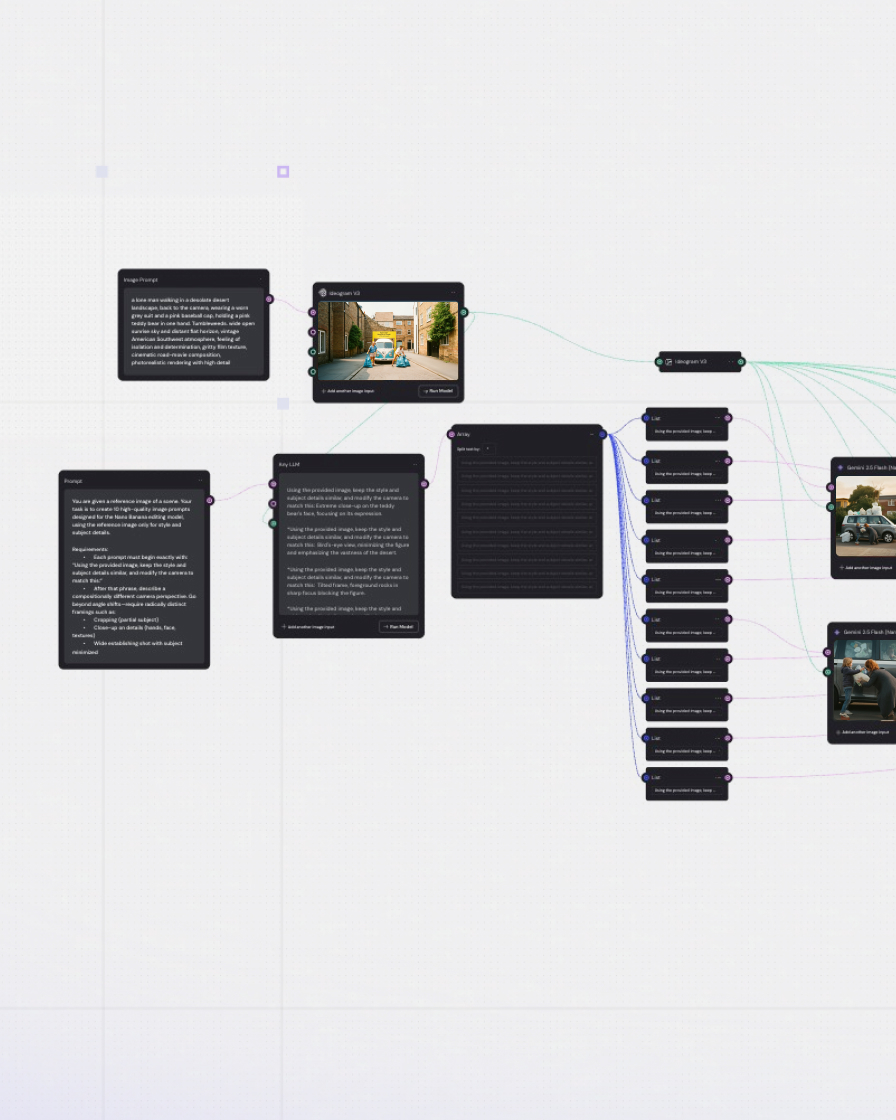
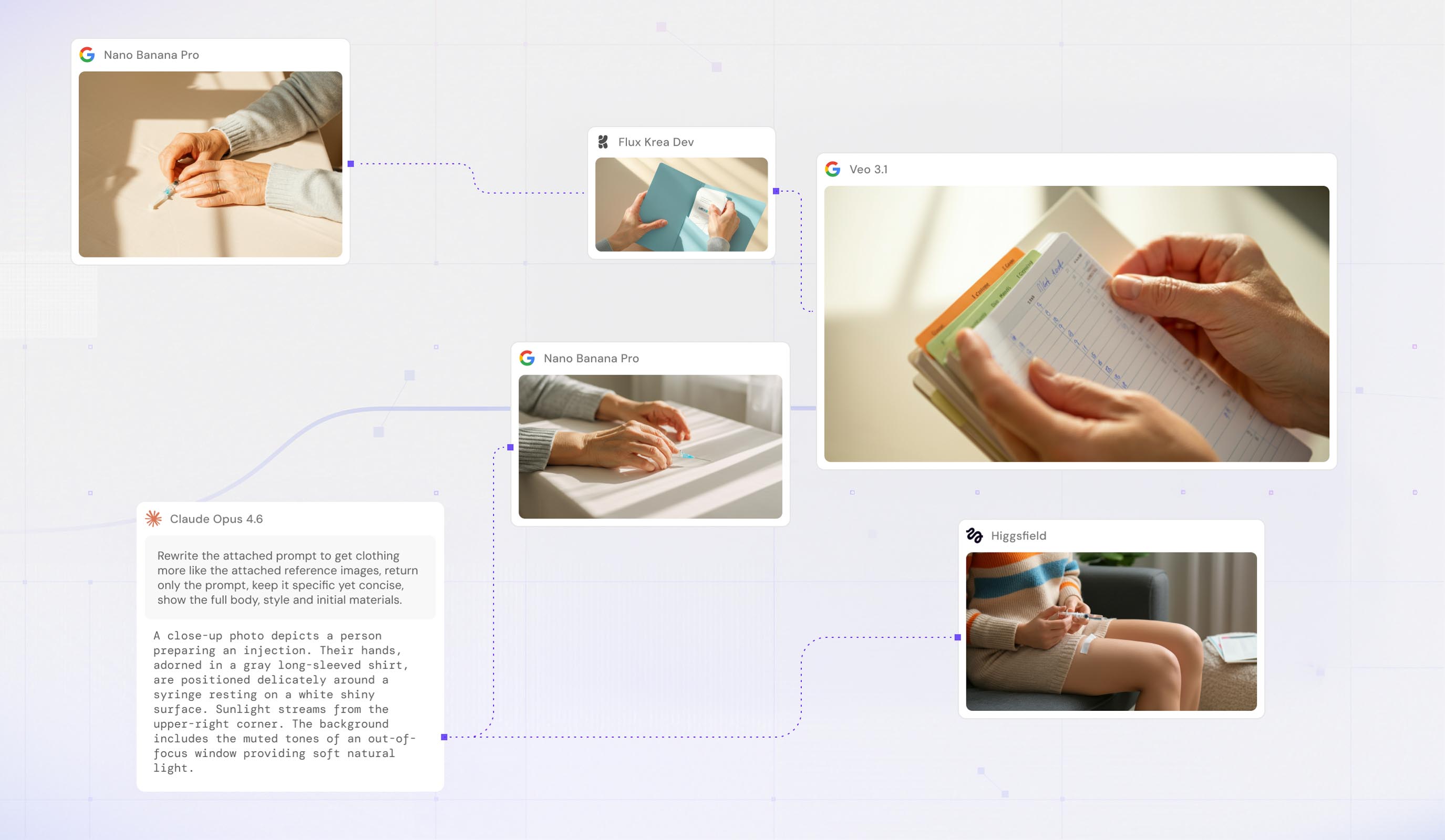
Because we've moved, quite rapidly, past "one-shot prompt and hope for the best." Node-based tools like ComfyUI , Flora or Weavy (soon to be Figma Weave?) finally give us granular control over image generation.
Instead of generating single images, we're building workflows and we're setting the rules upfront. What can vary? What stays fixed? What range are we're working in? Our feedback loops with AI aren't based on a single output anymore, but on the system producing it.
This means we can explore hundreds of directions fast. The workflow becomes reusable, project to project. Building that workflow is now part of the design work itself. We're not just designing visuals anymore, we're designing the process that makes them.
This approach requires the ability to think differently, to adapt. It's less about "make this" and more about "set up a system that can make many versions of this thing."
In practice, when clients review our work, they're no longer looking at three carefully crafted options. They're seeing dozens of variations, making it obvious which direction resonates. AI generated drafts aren't the final deliverable, though. They're rapid exploration tools that show us where to focus on. Once we have that direction, we build the real thing; the version that actually works.
Treat AI models as possibility engines, not sources of truth.
We don't accept AI outputs as final, but treat them as rapid sketches to react against.
We use them to stress-test assumptions quickly, explore directions we wouldn't have considered, move through the obvious solutions to reach something more interesting. They show us variations we might have missed.
When we're prompting for interface options, we're not asking "what's right?". We're asking "what are all the possibilities in this space?”. We don't treat AI like it's giving us the right answer. We treat it like it's showing us possibilities.
And, at the end of the day, the designer still decides what works. The designer matches the outcome with the users, the constraints, the strategy. And we are still the ones who'll build it for real.
A time of static deliverables is gone, enter generative UX/UI.
Today's interfaces are fixed. Designers define exactly what appears, when, and how. If behavior needs to change for different users or situations, someone manually redesigns it.
Enter generative UI.
Instead of hard-coding structures, we describe the intent and design rules, then let systems generate the right interface in real-time based on context. A dashboard that reorganizes itself based on what each user needs. A form that adapts its questions based on previous answers. Interfaces that respond to the situation, not just the clicks.
This means our work will shift. It will be less about crafting finished products, and more about creating systems that others can adapt and build on. We're designing infrastructure as much as we're designing interfaces.
Where it goes.
AI tempts us to move faster. To generate more and to ship quicker. But, at the end of the day, speed without direction just gets you to the wrong place faster.
For me, the real danger is in treating AI as a shortcut around developing judgment, intention, and craft. You can't learn to spot mediocre work if mediocre work is all you've seen. The next generation of designers needs to develop taste, and that takes time and care.
At Made, we're building reusable workflows that let us explore faster. We're treating AI as a possibility engine that shows us options we wouldn't have considered. We're designing systems that generate interfaces and visuals rather than designing the outputs themselves. It's about shaping a particular relationship without losing control. Knowing what quality looks like sits at the core of this new relationship.
Going forward, the tools will keep changing. The roles might shift as well. What won't change, for me at this stage, is the designer gap between professionals who understand why something works and people who just know how to prompt. Through my lens, this gap is even going to get wider, not narrower.
AI definitely raised the floor, but that means the ceiling matters more than ever. That's the new craft.


.jpg)