How manufacturers win in 2026.
Antwerp, Belgium - December 4th, 2025
By Kevin Verborgh,
Director of Manufacturing and Construction
The operational playbook that drove success in manufacturing and construction for the last few decades is broken. With 2026 rapidly approaching, unprecedented market pressure, from the 34% of global CO2 emissions tied to the construction sector to the rise of AI-driven, service-based competition, is forcing an industry-wide structural reset. Manufacturers must transition from being purely product-centric to becoming agile, data-native ecosystem providers.
In this article, Kevin Verborgh, Director of Manufacturing and Construction at Made, breaks down the three core challenges that leadership teams must master to lead, not lag, the industry over the next few years.



Redefining the operating model.
2026 is still under construction. Yet, many business executives are very much aware of the fact that this new year will not go by unnoticed. Current market dynamics are simply not as ordinary as they were once. Today’s industry challenges are not about managing technological upgrades or cyclical market corrections. A deeper shift is happening, as the operating model that has sustained industry growth for decades is starting to show considerable weakness. And here’s why.
For the better part of the last 30 years, success in manufacturing followed a familiar playbook: build reliable products, control your distribution channels, optimize your production efficiency, protect your margins, and scale gradually. At the core of it all? Product quality & linear value chains, both mostly offline.
Today, however, that model is revealing a deeper fragility. As many manufacturers are primarily organized around physical production, they are increasingly finding themselves in need to compete in a digital-first, service-driven landscape. This means artificial intelligence, circular business modelling, and platform economics are no longer optional add-ons. They are heavily redefining, as we speak, how value is created, determining at the end of the day who will lead or lag the manufacturing industry.
At Made, we believe that companies treating these forces as ‘temporary trends’ are at risk of falling behind significantly. Therefore, we strongly advise to look at 2026 as a structural industry reset, rather than a year to optimize around the edges.
Let’s zoom in on the biggest challenges.

AI as a strategy, not as an add-on tool.
When talking about innovation within the manufacturing and construction industry, many topics come to mind. However, there’s one that takes the cake: artificial intelligence.
More often than not, we’re seeing AI being framed as a tool in an efficiency play; a way to make smarter spreadsheets, write better articles, automate workflows, or build chatbots.
This, however, is only part of the picture. Not the entire story.
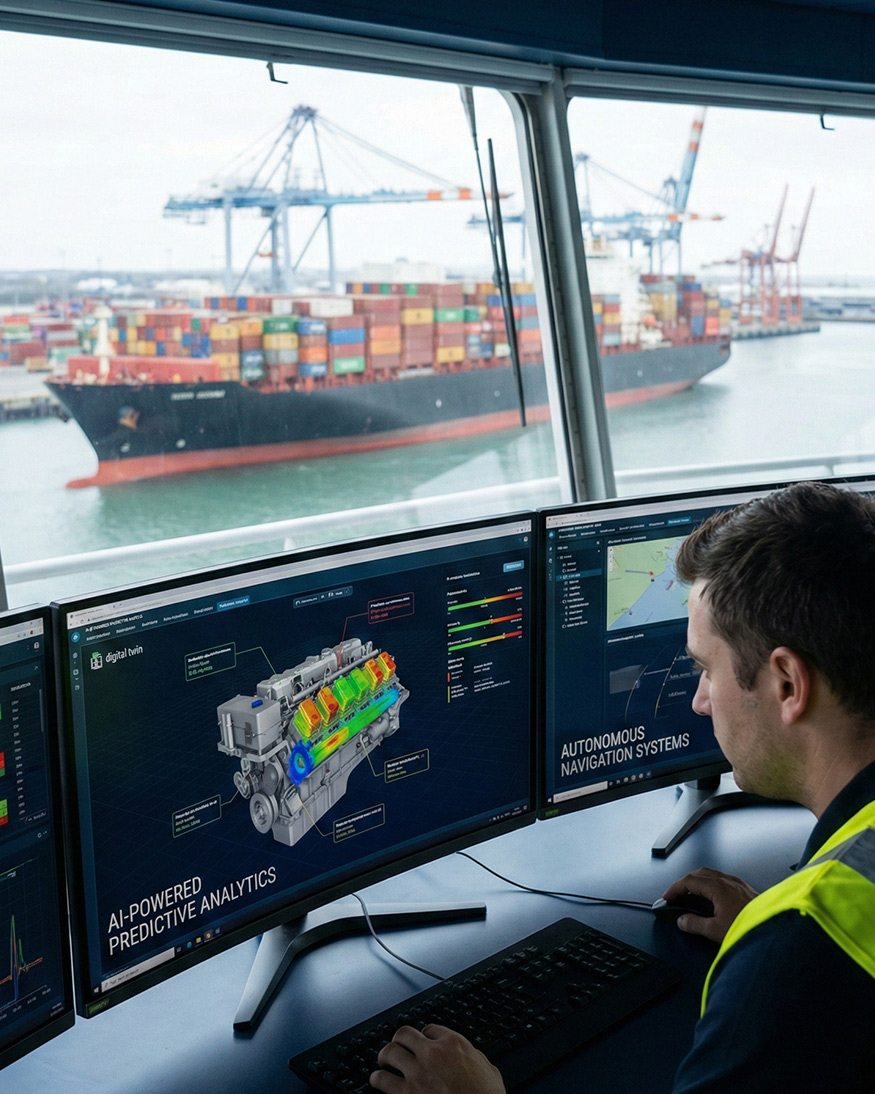
Across the construction and manufacturing value chain, AI reshapes how systems are designed, logistics are managed, pricing is determined, assets are maintained, and how services evolve after the sale. It’s basically becoming the backbone of contemporary decision-making, turning a reactive and linear approach into a predictive, dynamic, and continuous one.
Compare it with driving to a new address for the first time. Your GPS is set and from that point on, the app quietly decides: the route, the timing, the detours, the shortcuts. By the time you arrive, you’ve followed dozens of small instructions without questioning.
Manufacturing is heading in the same direction with the ‘GPS moment’ happening early in the process. Inside a BIM model or a configuration tool, for instance, where the system guides a designer or installer toward one specific set of products. Not because they love the brand, but because the workflow made the choice feel natural.
That’s the opportunity manufacturers have these days: control the route and you control the destination.
Let’s zoom in on HVAC units, for example. A few years ago, the installer made 90% of the decisions on-site: how to configure the unit, which settings to use, how to respond to unexpected pressure changes, … All manually decided and implemented, experience-based.
Forward-thinking manufacturers aren’t selling premium hardware alone, but an ecosystem that performs like a living organism. And because it’s connected, every real-time adjustment teaches the algorithm something new for the next project.
In the current day and age, cloud-connected systems quietly run diagnostics before the installer even arrives. AI flags incorrect pipe sizing, predicts energy consumption based on weather patterns, and suggests the most efficient configuration for that specific home.
So, the question rises: where does the decision truly live? Not in the installer’s head anymore. Not in the manual either. Decision lives inside the algorithm, which is why forward-thinking manufacturers aren’t selling premium hardware alone, but an ecosystem that performs like a living organism. And because it’s connected, every real-time adjustment teaches the algorithm something new for the next project.
So, a new question rises: where does the margin grow? Not in the hardware. Not with the installer. The margin grows where the value lies; in the connected system.
Manufacturers with the ambition to lead should focus on designing systems that leverage real-time data, dynamic configuration, predictive control, and constant optimization. They should be building service layers, on top of hardware solutions, that create value across the lifecycle. Not just at the point of sale.
When it comes to the use of artificial intelligence in 2026 and beyond, competitive advantage in the manufacturing space won’t come from creating better brochures, running creative marketing campaigns or speeding up production. It will come from building an AI-powered ecosystem that learns, adapts, and eventually outperforms over time.

The sustainability-driven value engine.
Apart from artificial intelligence, another burning topic is currently dominating the manufacturing boardroom discussions: sustainability. In recent years, too often than not, this topic has been living in strategy decks and ESG chapters, but failed on many occasions to guide actual business decisions.
In many boardrooms, sustainability was treated as a compliance requirement, a reporting exercise, or at best, a reputational asset. Today, things are different as sustainability is becoming a core engine of value creation and a defining pressure on how manufacturing businesses are designed.
The construction industry already accounts for 34% of global CO2 emissions and consumes 32% of the world’s energy. Cement production alone is responsible for roughly 8% of global emissions. These numbers are not abstract. They are economic indicators of risk and opportunity. And they are beginning to shape everything from procurement regulations to project financing criteria.
In addition, they are unlocking new forms of margin as well. Looking at ‘waste’, for example; waste is no longer just a cost to be minimized. It is becoming an asset to be monetized. Companies are discovering value in material take-back schemes, in refurbishment programs, in second-life component markets, and in building elements designed for disassembly and reuse. The shift is not simply about lowering emissions. It is about rethinking how value flows across the full lifecycle.
Companies are discovering value in material take-back schemes, in refurbishment programs, in second-life component markets, and in building elements designed for disassembly and reuse. The shift is not simply about lowering emissions. It is about rethinking how value flows across the full lifecycle.
A great example of a manufacturing business that really lets sustainability dictate business decisions, is Etex. Etex has been piloting gypsum take-back schemes in several European regions. Contractors return offcuts, broken boards, or dismantled partitions, and Etex reprocesses the material into new gypsum products. By doing so, they reduce raw material use and, more interestingly, they create a supply loop that becomes cheaper and more predictable over time. Suddenly, waste becomes a feedstock and sustainability becomes a strategy.
In 2026 and beyond, running a circular business model is no longer a niche play. It is a standard operating model for manufacturers that want to stay relevant over time. The manufacturers that win in this space will not be the ones with the most impressive carbon dashboards. It will be the ones who turn regulations into revenue streams, and see sustainability as a strategic advantage, not as a trade-off.
And that’s exactly what we do at Made. We work shoulder to shoulder with leadership teams to design operating models that work in the real world, in a market where materials are scarce, regulation is heavy, and the pressure to adapt is very, very real.
Shift from product to platform.
The final challenge for manufacturers that I want to highlight in this writing, is product differentiation. Because, when walking through any construction site, you'll encounter a fundamental challenge manufacturers are facing nowadays: their products have become pretty much indistinguishable from competitors'.
From pipes and wall panels to HVAC units and insulation materials; they all look similar, if not exactly the same. Chances are the installer doesn’t even know (or care?) who made the damn drywall.
In this environment, product quality alone no longer drives brand preference. That brings us to a third challenge for manufacturers in 2026 and beyond: coping with the risk of commoditization.
The center of gravity here is moving away from the product itself. Differentiation now lies in the specification, the workflow, and the data layer. Whoever owns those elements will own the user, the margin, and the long-term relationship. Hence, the traditional product-centric model, where differentiation lives in materials, features, or certifications, is giving way to a platform logic. Here, manufacturers must ask a different set of questions.
Are we integrated into our customers’ workflows?
Do we enable better decisions upstream?
Can we deliver data-driven value after installation?
Are we part of the spec, or just a commodity on the purchase order?
In 2026 and beyond, value will continue to shift radically toward the ecosystem wrapped around a physical product. Manufacturers who build these layers of service and data will unlock growth in places competitors can’t even see. Those who believe products alone can carry growth will be stuck constantly justifying price in a race to the bottom.
Platform-thinking manufacturers embed configuration tools into digital design platforms. They launch service portals that handle training, maintenance scheduling, and retrofit planning. They build procurement interfaces that align with contractor workflows and lead times. These layers may seem like small software features, but they are strategic service-based differentiators in a commoditized market.
Most importantly, these companies establish real connections. Not through flashy marketing campaigns, but by embedding themselves in the tools and decisions that drive projects forward. They are no longer just vendors. They are infrastructure.
In 2026 and beyond, value will continue to shift radically toward the ecosystem wrapped around a physical product. Manufacturers who build these layers of service and data will unlock growth in places competitors can’t even see. Those who believe products alone can carry growth will be stuck constantly justifying price in a race to the bottom.
Plot twist: the biggest barrier is not technology.
For all the talk about AI, circular models, and digital transformation, the real challenge connecting all of them is not external. It is the legacy structure within the organization itself.
Most manufacturers are built for physical production. This is a liability when the industry shifts toward digital products, real-time decision systems, and platform-based services. This is one of the main reasons why so many AI programs stall. Why sustainability strategies fail to translate into operations. Why service differentiation gets stuck in pilot mode. The organization isn’t designed for iteration, or experimentation. It’s optimized for consistency, repetition, speed; not adaptability.
Furthermore, the drive for AI and sustainability is inextricably linked to the war for talent. Tomorrow’s engineers and architects demand to work on products that matter and leverage cutting-edge technology. Manufacturers who fail to embrace this structural reset are not just creating obsolete operating models; they are making themselves irrelevant to the next generation of top talent.
Most manufacturers are built for physical production. This is a liability when the industry shifts toward digital products, real-time decision systems, and platform-based services.
For manufacturers to lead in 2026 and beyond, they need to entirely rethink ‘how’ they build. Not just ‘what’ they build. Teams now are usually divided by function, not by outcome, and thus approval sometimes can take ages. A digital product manager has to speak with 8 departments just to adjust a button in a configurator. And the installer, the person who actually decides whether your product gets chosen again, sits miles away from anyone who designs the tools meant to serve them.
The companies that break through this pattern will be the ones that treat organizational design as a strategic priority.
At Made, this is the core of our work. We help manufacturers move beyond strategy and into execution, building the internal teams, processes, and delivery systems that turn ambition into velocity. Whether it’s an AI-native retrofit service, a circular business model, or a new digital product line; the outcome depends not just on the idea, but on the team built to deliver it.
If you’re wondering where to start, you’re not alone. Acknowledging the shift and seeing the opportunity puts you already ahead of many. And that’s a pretty exciting place to be.